Raipur (Chhattisgarh) [India], October 16: The scope of journalism and mass communication now spans five clear career paths: news reporting, broadcast, digital content, PR and corporate communication, and documentary or independent media. The journalism and mass communication course at AAFT University Raipur, a B.A. degree, trains students for all five in campus studios.
Journalism today is far more than newspapers and news channels. It also covers digital media, content, PR and brand storytelling. So a media degree leads to a wide set of careers, and this guide maps where it can take you.
AAFT University of Media and Arts in Raipur, Chhattisgarh, offers the B.A. in Journalism and Mass Communication as a three-year degree, with an optional fourth Honours year, and the two-year M.A., through its School of Journalism and Mass Communication. The 2027 batch is now open for applications.
Is a Journalism and Mass Communication Degree a Good Career?
Yes. Roles across media, digital content and communication are multiplying across India. Trained communicators are wanted in news, brands and agencies. So a journalism and mass communication degree is a strong, modern choice.
Pay varies by path. Digital and PR roles often start higher than print, and anyone with a strong portfolio of published or broadcast work moves up faster.
What Is the Scope of Journalism and Mass Communication in India?
The scope is wide because India’s media economy is large and still expanding. Here is the market behind it, in numbers.
· A large market. India’s media and entertainment sector grew 9% to ₹2.78 trillion in 2025 (FICCI-EY 2026).
· Digital is the biggest employer. Digital media crossed ₹1 trillion in 2025 and took 63% of India’s advertising spend (FICCI-EY 2026).
· Audiences pay for digital. Digital subscriptions grew 60% to ₹163 billion in 2025 (FICCI-EY 2026).
· Employers have multiplied. Brands, agencies and startups now hire media graduates well beyond the traditional newsroom.
So the scope reaches far past reporting alone. A media graduate can move into digital journalism, PR, brand content or independent media, which suits students who are not yet sure which lane fits them.
Job security in the media comes from this range, not from a single employer. When one lane slows, trained communicators shift to another, from a newsroom to a brand team or a content studio. So a broad media degree is a hedge as much as a passion.
Demand is also spreading beyond the metros. Regional news, local digital brands and creators now need trained communicators too. So the field is opening up for students from every part of the country, including Chhattisgarh and central India, where regional-language media is growing fast.
What Jobs and Pay Can You Expect in Media?
Your pay grows with your skills and your portfolio. These are the common paths after a journalism and mass communication degree.
| Career Role | Where They Work | Typical Salary (industry estimate) |
|---|---|---|
| Reporter / Correspondent | News channels, newspapers, wires | ₹3–6 LPA |
| News Anchor / Producer | TV, OTT news, broadcast | ₹4–8 LPA |
| Digital Journalist / Content Creator | Digital news, brands, startups | ₹4–8 LPA |
| PR / Corporate Communication Executive | Agencies, corporates, media | ₹4–9 LPA |
| Documentary / Media Entrepreneur | Independent, production houses | Varies with the work |
Senior editors and communication leads often earn ₹10 LPA and above. Figures are industry estimates, not promised outcomes.
The Careers a Journalism Degree Opens
A journalism degree does not lead to one job. It opens several lanes, and you choose the one that fits you.
· Newsroom and reporting. You report for newspapers, wires and news channels.
· Broadcast and anchoring. You anchor and produce for TV and OTT news.
· Digital and content. You create news sites, brands and social media.
· PR and corporate comms. You handle agencies and company communication teams.
· Documentary and ventures. You make documentaries or build your own media brand.
You are not tied to one lane on day one. The early years build shared media skills across all of them, and you specialise as your interest grows. So the degree keeps your options open while you find your direction.
Tools and Specialisations You Can Master
A media degree is not only theory. You also learn the tools that newsrooms and brands use, and you can lean into a focus.
· Video and broadcast. Video editing and news-package tools for broadcast and digital.
· Audio. Recording and editing tools for radio and podcasts.
· Visuals. Photo and design software for visual storytelling.
· Digital. Content, SEO and social tools that track reach.
Within the degree, you can specialise in broadcast journalism, digital and content, public relations, advertising, or documentary and media research. So two students can leave the same course on very different paths, and you can shape yours as your interest sharpens.
What Will You Learn?
The degree covers the full craft of media, step by step. You start with print, mass communication and photography, then add radio, television production and video editing. Later you take on PR, advertising and political communication.
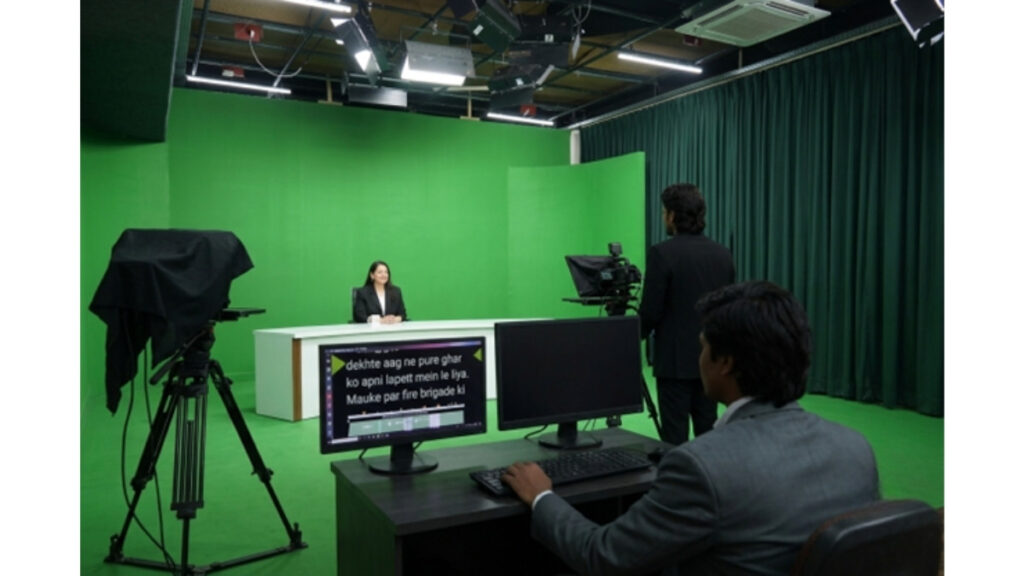
You train in real studios, not just classrooms. The campus has an in-house TV studio, a radio station and post-production labs, where you make live news bulletins, radio shows, podcasts and digital content. So you finish the course with a portfolio already in hand.
The course also stays current with how media actually works today. You study mobile journalism, data-led reporting and social-first content, and you learn to spot misinformation. So you graduate ready for newsroom jobs and digital media roles alike.
Which Journalism Degree — BA or MA?
AAFT University runs a clear route at both levels. The B.A. runs for three years, or four with Honours, where the Honours year adds documentary production, research and media ethics. Graduates can continue with the two-year M.A. in Journalism and Mass Communication. You can apply from any stream, whatever you studied at school.
| Programme | Duration | Best For |
|---|---|---|
| B.A. in Journalism and Mass Communication | 3 / 4 Years | News, digital, PR and broadcast foundations |
| M.A. in Journalism and Mass Communication | 2 Years | Advanced reporting, research and media leadership |
You need a 10+2 pass from a recognised board to apply. Selection is through the AAFT Global Entrance Exam (GET) and a personal interview.
What Skills Will You Build?
Beyond tools, a few core skills decide who thrives in the media.
· Writing. Clear, accurate writing under real deadlines.
· Presentation. On-camera and audio presence for broadcast and digital.
· Judgement. Research, sourcing and the habit of verifying facts.
· Craft. Storytelling that works across print, screen and social.
These are the skills recruiters look for in a portfolio. The course builds them through real newsroom and studio work. Because you practise on live bulletins and shows, you build confidence long before your first job interview.
Who Should Study This Degree?
A media degree suits a certain kind of student, so it helps to check the fit.
· You are curious. You are curious about news, people and the world around you.
· You communicate. You like writing, speaking or telling stories.
· You are expressive. You are comfortable on camera, on audio or on a page.
· You want range. You want a creative career with many possible directions.
If that sounds like you, this degree turns those instincts into a profession. The studio training then gives you the proof to get hired. And if you are still exploring, the broad first year lets you sample reporting, digital, radio and PR before you commit.
Why Choose AAFT University for Media?
A few things make this a strong place to study journalism and media.
· A recognised degree. A recognised university degree, offered on a three or four-year Honors track.
· Real infrastructure. An in-house TV studio, radio station and post-production labs.
· Broad training. Training across news, digital, PR and broadcast in one course.
· A known name. Part of the wider AAFT group and its media legacy.
Together, these turn a degree into a real start. You graduate with a portfolio, studio hours and a clear route into media. The Raipur campus also offers a full university experience at a lower cost than the big metros, which matters for many families.
Who Will Teach You?
The School of Journalism and Mass Communication is led by working media educators. You learn from people with real newsroom and teaching experience.
· Faculty. Ms. Ankisha Mishra is an Assistant Professor in the School of Journalism and Mass Communication.
· Faculty. Ms. Rashmi Priya is an Assistant Professor, supporting students across the media pipeline.
· Industry input. Working media professionals and guest experts support the teaching team.
Because your teachers know the newsroom, the feedback reflects real deadlines and standards. Guest sessions also connect students to people already working in the field.
In Their Own Words
Dr. Sandeep Marwah, President, AAFT University, said: “Media has never offered more career paths than it does today. Our students train in real studios, on real newsrooms and shows, from early on. They leave with a portfolio and skills for many media careers. Some report the news, others build digital, PR or content careers. Watching them find their place in the media world is what we are proud of.”
Where Do AAFT University’s Media Graduates Work?
This degree is designed around getting graduates hired, with support running through every year. According to AAFT University, its graduates have joined national and regional news channels, digital newsrooms and communication teams. Live projects and studio work help them reach these roles.
Applying to AAFT University in 2027
Entry is decided by the AAFT Global Entrance Exam (GET) and a personal interview. A 10+2 pass from a recognised board is the basic requirement. Places in the 2027 batch are limited, so applying early on aaft.edu.in helps.
Frequently Asked Questions
What is the scope of journalism in 2027?
Wide. Digital media is now India’s largest media segment, and brands hire communicators as well as newsrooms.
What is the salary after BJMC?
Freshers usually start at ₹3–5 LPA, rising with skill and portfolio.
Is there an Honours option?
Yes. The four-year Honours route adds documentary, research and media ethics.
Can I study journalism in Chhattisgarh?
Yes. AAFT University’s Kharora campus near Raipur offers the B.A. and M.A.
About AAFT University
AAFT University in Raipur belongs to the AAFT group, which carries a creative-education legacy of more than 30 years. It focuses on media, arts and design, offering degrees built around industry needs. It is known for tying classroom learning to the working world of news, media and communication.
The journalism degrees run through an in-house TV studio, a radio station and post-production labs. Students learn on the same tools used across the media industry. Experienced faculty teach alongside people working in the media business.
The academic model balances theory with real newsroom and studio work. A dedicated placement cell guides students from the classroom into their first roles. AAFT University stays committed to building industry-ready talent for India’s media economy.
For Admission and Media Inquiries, Contact:
AAFT University
Vill. Manth, Kharora, Raipur, Chhattisgarh 493225, India
Phone: +91-9109112078 / +91-8064057209
Website: www.aaft.edu.in
Sources: FICCI-EY Media and Entertainment Report 2026 (March 2026). Salary ranges are industry estimates, not promised outcomes.
If you object to the content of this press release, please notify us at [email protected]. We will respond and rectify the situation within 24 hours.